Saturday, June 2, 2012

Folks, go for swimming in this scorching heat…………!


Like every year this year also I was glad as my swimming session would be starting this June. In Allahabad we have many pools but as I am associated with district sports authority as a tennis player from more than a decade, I do swimming too in government swimming pool. Most of you can think why I go for government and not private? The answer to that is in spite of all odds this is the best in the town, not only Olympic size, biggest but the finest.  


Swimming is one of the best activities that you can perform for overall physical fitness. Swimming involves almost all of your major muscle groups. For example, the standard crawl stroke uses the neck, shoulder, chest, back, triceps, and biceps muscles of the upper body, the abdominal, low back, and oblique muscles of the midsection, and the gluteal, quadriceps, hamstrings, and calf muscles of the legs. On the other hand, swimming is an excellent exercise for conditioning your cardiovascular system. Although you won't go as far in a 20-minute swim as you will during 20 minutes of walking, running, or cycling, the cardiovascular benefits are essentially the same.


Identically, swimming seems to enhance joint flexibility, especially in the neck, shoulders, hips, and midsection area. Much of this is due to the repetitive twisting movements as your body turning from side to side during the crawl stroke. Of course, exercising in water is a totally different experience than land-based activity. For one thing, swimming requires a horizontal body position, that places less stress on your heart with respect to blood circulation. The gentle pressure of the water against your skin also enhances blood circulation. Because water is an isokinetic medium, the resistance varies in proportion to your muscular force. That is, when you give low muscle force against the water you encounter relatively low resistance from the water, and when you give high muscle force against the water you receive relatively high resistance from the water.


Another advantage of aquatic exercise is the cooling effect of the water. Unlike the hot weather activity on land, you are unlikely to overheat when swimming. What could be better than a cool pool, lake or ocean in which to exercise on a hot summer day. With so many reasons to enjoy swimming, why do so few adults spend time in the water? The major problem for some adults is the lack of confidence in their swimming ability. This can be easily overcome by a few lessons or a refresher swimming course.


However, I find that most adults do not understand how to swim long enough for the fitness benefits. To make a land activity analogy, they start out running rather than walking. In other words, instead of starting with a slow swimming speed and gradually picking up the pace new swimmers tend to sprint a lap or two, exhausting themselves and ending their exercise session prematurely. By so doing, they miss both the enjoyment and the fitness benefit of this fine physical act

Even though swimming is excellent exercise, it should be performed in an unperturbed manner. Your arms and legs should feel loose and your movements should be balanced and coordinated. If you feel tight or tense, simply slow down and let the water work with you rather than against you. Because the water buoys up your body, you can swim very slowly and still maintain your top-of-the-water body position.


By the way, unless you want to swim competitively, do not compare yourself with other swimmers. Bodybuild plays a major role in swimming speed, but it has little effect on your fitness outcome. For example, people who are wide from side to side and then from front to back seem to skim over the water surface like a surfboard. On the other hand, people who are narrow from side to side and thick from front to back encounter much more water resistance and must work much harder at a given swimming pace. The solution is to swim for yourself at a comfortable speed, and let the faster swimmers use the high speed lanes. As an aerobic conditioning activity, you should aim for at least 20 minutes of continuous swimming. However, until you develop sufficient cardiovascular endurance, you may vary the pace throughout your 20-minute swimming session.


At last I must articulate, Summers are here and now the best way to shed those extra calories is definitely swimming. Therefore no need to struggle in the gym when you can just bid adieu to those fat cells by soaking yourself in the cool swimming pool. People who only come for time pass in the pool should avoid because they not only disturb senior players like me but also play with their lives in deep water.


Happy Summers!
Happy Swimming!


Prateek Pathak
Student
B.A in Media Studies
University of Allahabad

Friday, December 2, 2011

Seeing positive experience of other Countries the FDI policy debate in India seems unreasonable...


The recent hullabaloo over foreign direct investment in retail sector has unnerved Parliament into hysteria. The first inkling I got from the opposition by BJP, is this same party which was mooting 100% FDI in retail sector nine years ago. The Chief Ministers of Uttar Pradesh, Bihar, Tamil Naidu and how can we forget West Bengal have vowed not to permit FDI in their states. Mamata Bannerjee, who usually act the character of opponent within the UPA government and has presently walloped a populist pose on retail, she should spot where the bona fide interest lie. The BJP might plausibly put on by tripling up the UPA, Trinamool Congress unquestionably won’t.


In veracity the, far-off multi-brand retailers cannot wholly substitute mom-and-pop stores, but undoubtedly create more jobs and momentously, are associated with revenue generation and overall economic development. As the chosen rulers, the Chief Ministers of all states should mull over the philosophical impact that the retail sector has on a country’s socio-economic development. Our economic expert PM. Singh will do well to remember that the economy is in parlous state.


Retailing in mature markets, without similar FDI constraint, employs proportionally more people as well as provides greater education, training and personal development opportunities.


The familiarity of other states should enlighten the guideline dispute in our country. Retailing in middle-aged bazaar without parallel FDI constraint, such as England, provide work for comparatively more people (10.5 % in England versus 8.2 % in India), as well as endow with superior education, training and personal development opportunities. In nations like Brazil, Malaysia, Thailand, lessening of FDI has turn out to be, lessening of unemployment and amplified revenue generation for the economies as a whole. Moreover this might results in shutting down of some neighborhood stores due to inefficiency.


With proper political management Congress can ride out the present FDI crises.


Furthermore, the current FDI policies allow state governments to latitude to march in and grant the incentives and fiscal support to perk up the competitiveness of the mom-and-pop stores. This is what the Malaysian government did when it liberalized the retail sector in 95. There is to a large extent global skill that state governments can hear from.


The definition of Retailing is to provide right product at the right price at the right time to the customer. Accordingly the mom-and-pop stores supply three chief advantages- location, time of delivery and tailored recognition. Those qualities are almost impossible to replicate in modern retail shops. It also includes home delivery, year’s relationship with retailer and mutual trust. This is the very reason why till now we have more consumers in mom-and-pop stores but not in a small modern retailing like Food Bazaar or Spencer.


The BJP might conceivably gain by tripping up the UPA, Trinamool Congress certainly won’t.


In India, stat shows retailing is second largest employer after agriculture. If at this point Congress tries to role back it would spell out the end of the Indian story, as it would indicate government failure. If BJP can arrange the traders bandh as we saw yesterday why not Congress appeal to the farmers and consumers. If would act if it gets words of support from allies like Sharad Pawar, who is seen representing the interests of the farmers.


Bracing FDI limitations in a coordinated and managed way offers the leeway not only to give consumers new options but also could provide benefits to farmers, manufactures and small business enterprises.


The FDI stroke gives a break to State Governments to artistically enclose their own canon and smash their own limitations and admonition. If the Chief Minister of some states do not want FDI in their representative state that too is possible. Let them guard their citizens from profits and expenditure that might mount up to other states. To oppose this stroke on the national level seems irrational based on experience somewhere else. In spite of an open market, no one retailer dominates European retailing, you should have solid reason for your opposition. India too can be same as Europe to set its own priorities and principles. It is the time to climb above wobbly and tenuous affirmations. India’s future financial and societal growth is at venture.


Prateek Pathak

Student

B.A in Media Studies

University of Allahabad

Tuesday, November 22, 2011

Will you eat your Physics, Chemistry or Engineering Degree?


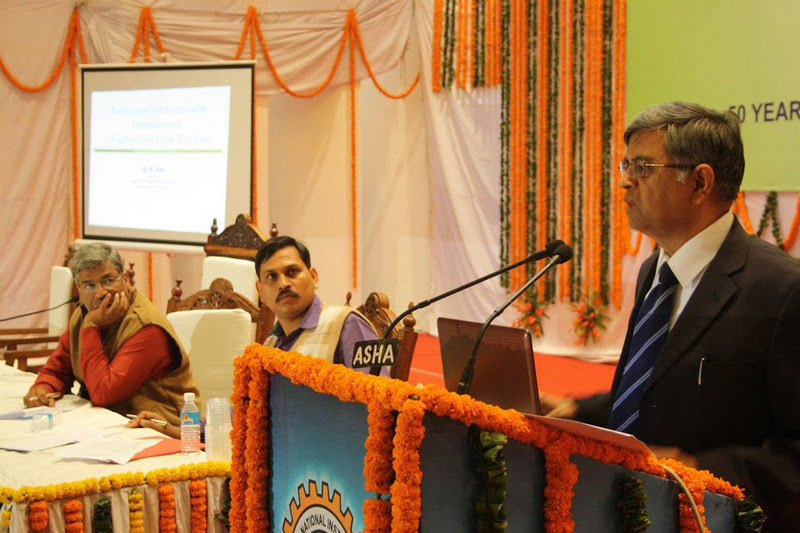
‘My interpretation on sustainable development is that the development which result in social harmony not social unrest. Handful are richer more are poor what type of technology is it. 75% commoners are only earning 20 rupees per day. Eating ratio in a day has decreased in this last decade. Problem is unemployment. You will eat your physics, chemistry or engineering degree? When jobs are not there what is it to pass out from famous institutes. You should have knowledge of economy to solve these problems, technology would not solve. We have to introduce technology in agriculture. Government policies in the urban centers should be reversed. Problem is how to raise purchasing power. We can increase the production of say steal or chemicals, but the major problem is how will we sold. You should increasing purchasing power in urban areas. Farmers should become more prosperous. Unless farmers will not make profit how will they buy industrial good? Because of low purchasing power manufacturing jobs are also declining. At present prices are skies rocketing. Every parent wants to see their kids in IIT, but it cannot be true. ’- these lines were delivered by Justice Markandey Katju, Chairman, Press Council of India, who was the Chief Guest in inaugural function of Golden Jubilee Conclave on Technology For Sustainable Development.


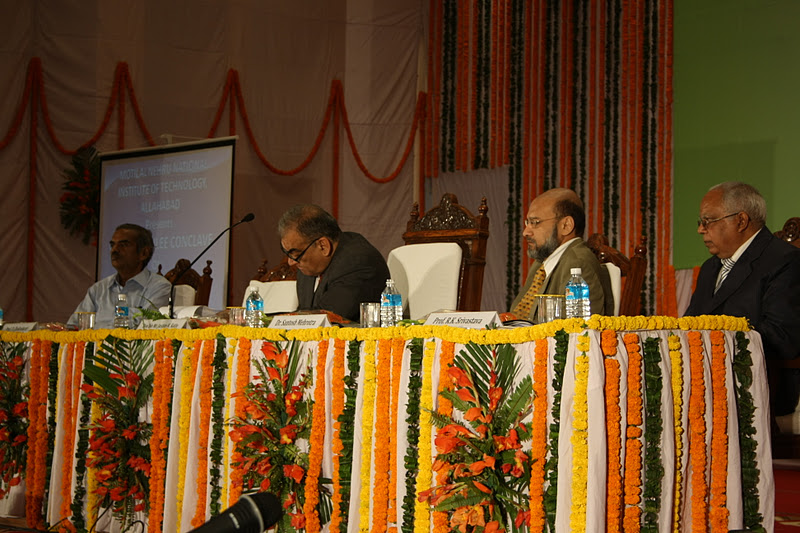
At the M.P hole of Moti Lal Nehru National Institute of Technology, Allahabad the function started by the lecture of Guest of Honour, Dr. Santosh Mehrotra, Director General, institute of Applied Manpower Research, Government of India. He started by saying number of poor have not decline Young people should be used for the development of the nation. We should use technology for sustainable development. Water table is declining. Only 40% land is irrigated 60% depends on rain. Why manrega in the country is so important because it is creating asset which will save rain water. As we grow we would industrialize, we need land for that. Mining in unplanned manner is there both in legal and in-legal manner. You can’t go on displacing Adivasi. We have no action plan for climate change. China is 20 years ahead of us because it relied on solar, pekoe micro hydra. We can take the example of Allahabad where there is electricity in most of the houses but there is a 6-8 hours power cut. I would like to challenge the youth how solar can be used. He concluded by words of Mahatma Gandhi- ‘If you want to see change be that change.’


The conclave had the invited lectures by some of the prominent experts. This includes personalities like Prof G.K Rai, Director, Institute of Professional Studies, University of Allahabad who delivered his lecture on Technology and Sustainable Development-finding our way out. He started by saying there is no harm if we are adopting western model. We cannot desire that a small kid will have the deep knowledge of culture. One and all cannot be a scholar. He also compared America and Africa and showed some analytical statistics. He concluded by saying ‘Poor man can be rich in terms of happiness’.


Other speakers were Prof K.S Rao, IIT, Delhi who spoke on Sustainable Infrastructure Development, Prof D.K Srivastava, Director, Madras School of Economics, Chennai, who spoke on Sustaining India’, Prof Kiran Seth, IIT, Delhi, who spoke on India’s Core Competence, Dr. G.N Pandey, who spoke on Nuclear Energy for national development, Prof Chandan Ghosh, NIDM, Delhi who spoke on Sikkim Earthquake 2011, Prof. S.K Joshi, NPL, Delhi who spoke on Sustainable Development-Needs a realignment of engineering education, Prof D. Bandopadhay, Vice Chancellor, GGIP University, New Delhi who spoke on Sustainability in the paradigm of Management & Policy, and Prof M.M Pant, who spoke on Education and Sustainable development.


The conclave had many students and faculty members of different colleges of Allahabad. The conclave’s inaugural function was preside by Prof. P Chakrabarti, Director, Moti Lal Nehru National Institute of Technolgy, Allahabad.


Prateek Pathak

Student

B.A in Media Studies

University of Allahabad